Showing posts with label Architecture. Show all posts

Sunday, November 9, 2014

Event Report: Doors Open Milwaukee 2014, Part 1


Local author John Gurda lectures a full house of visitors on the history of the Basilica of St. Josaphat.

Doors Open Milwaukee (DOMKE) is an annual event where many institutions in the City literally open their doors for tours by the general public.  What is perhaps most wonderful about this event and others like it is that it gives folks of all persuasions the opportunity to go explore and become a greater part of the city that they live in (or in my case be interested in).  Apparently this concept is not lost on the Catholic Church in Milwaukee, as several parishes and other Catholic sites participated in the event in September.


I ventured to several religious and secular sites in my visit to DOMKE 2014.  The first of which was the chapel and crypt at Calvary Cemetery, in the Story Hill neighborhood.  Mounted on the highest hill in the cemetery near the end of the 19th Century, it has stood in a practically abandoned state for nearly fifty years.  However, the group Friends of Calvary Cemetery are in the process of restoring the chapel.


Left: Altar inside the chapel.
Right: Rose window above the chapel portal.


The only occupied resting place in the basement crypt, for Father Idziego Tarasiewicza.
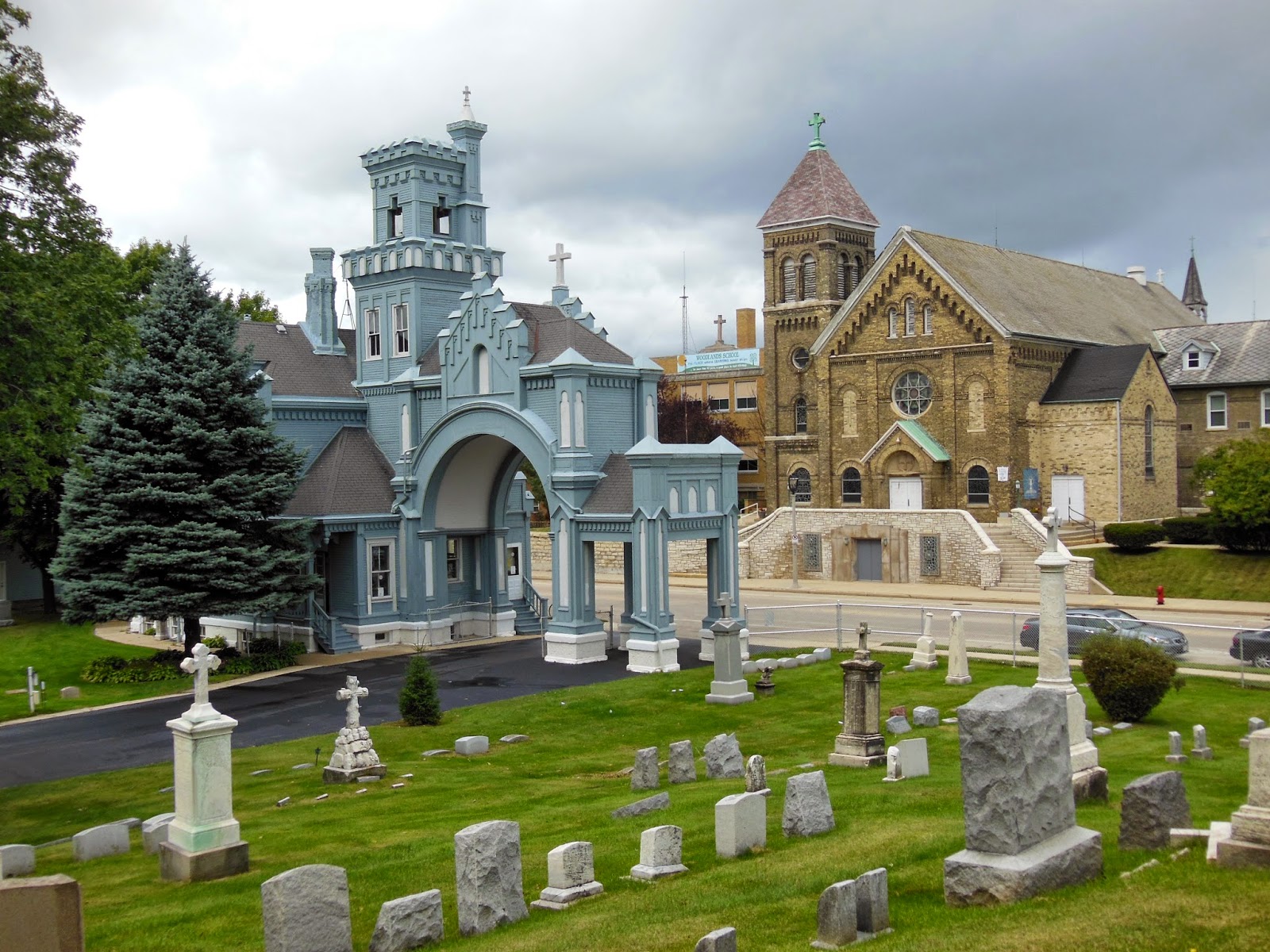


Entry to Calvary Cemetery, with Holy Cross Church, part of St. Vincent Palotti Parish, across West Bluemound Road.


Chapel for the Sisters of St. Francis of Assisi.


Left: A announcement for the Sisters Adoration Chapel.
Right: One of two impressive reliquaries in the main chapel.


Christ King Chapel at St. Francis de Sales Seminary, nearly adjacent to the Sisters' home near Milwaukee's southeastern-most city limits.


St. Francis de Sales Seminary is the oldest continually-run seminary in the United States.


A highlight of the day was certainly the lecture at the Basilica with local historian John Gurda.  Gurda has made the City of Milwaukee a personal study for over forty years, and his knowledge of the City and connection with the Basilica neighborhood helped fill the pews for a nearly hour-long talk.  I was five minutes late and was relegated to the narthex doors.  


It's possible that the most photogenic holy water fonts I've ever seen reside at the Basilica.


Part 2 forthcoming pending some Photoshop-ing.


Sites visited in this post:

The Basilica of St. Josaphat
http://thebasilica.org/

Calvary Cemetery
Friends of Calvary Cemetery: http://www.friendsofcalvarycemetery.org/

Sisters of St. Francis of Assisi
http://www.lakeosfs.org/

Sisters of St. Francis of Assisi
http://www.sfs.edu/SFSHome

Additional Sources and a Disclaimer
I have been volunteering and been enthusiastic about the effort that Doors Open Milwaukee and its mother organization, Historic Milwaukee, Inc. have made for over two years now.  Certainly I believe their annual event is worth attending, along with the numerous other programs that Historic Milwaukee, Inc. puts on.  The basic facts that I shared in this post come from Door Open Milwaukee's event guide, available at: http://doorsopenmilwaukee.org/buildings/

Friday, June 13, 2014

Feast Day of St. Anothony of Padua


This post takes us well outside of the Midwest to the Chapel of St. Anthony of Padua in St. Matthew's Cathedral in Washington, DC.  Downtime on a recent work trip gave me the opportunity to revisit this church that I regularly visited while interning at National Geographic magazine a few years back.  For context, the chapel is off to the right side of the nave if you are facing the altar from the rear of the church.  Despite its status as a side chapel in the larger cathedral building, it was actually the first part of the cathedral to be dedicated, in 1898.


Beyond the altar in the chapel is a wooden statue of St. Anthony and the Christ Child.


Details of the columns surrounding the chapel.  I believe these pedestals, along with much of the marble-work in the chapel, were actually carved out in Italy.  

Note the one on the left, where you see the impression of Christ's face with the crown of thorns.  This recollects the moment while carrying the cross where Jesus wiped his face in St. Veronica's cloth, leaving behind an impression of his face.  Probably not by coincidence, St. Veronica is often referred to as the patroness of photographers.


Perhaps the real highlight in the chapel is the series of mosaics of St. Francis and his followers (St. Anthony of Padua was a Franciscan priest, and thus one of these folks).  These mosaics, installed in 1963, are paired with lines from St. Francis' Canticle of the Sun.  Above, St. Francis pictured with a wolf he reputedly tamed.


St. Francis, with the church of Santa Giuliana in Spoleto, Italy.


Sts. Clare and Jacopa dei Settesoli.


Cathedral of Saint Matthew the Apostle
1725 Rhode Island Avenue, NW Washington, DC 20036
http://www.stmatthewscathedral.org/

This post heavily relies on notes from the book Cathedral of St. Matthew the Apostle, which I purchased at the Cathedral after neglecting to do so on my regular visits four years ago!  Published 2008, referencing page 38.

Tuesday, June 10, 2014

Feast Day of St. Margaret of Scotland


Another impressive church from the Gateway City, St. Margaret of Scotland is a fixture in the Shaw neighborhood on the south side.  In over two and a half years of living near St. Louis, I only visited this church once, on a Saturday afternoon well before Mass.  To add insult to injury, all the lights were off, really limiting the photo ops.


A quick consultation of Butler's Lives of the Saints states that St. Margaret (d. 1093) was instrumental in having churches and monasteries built while Queen of Scotland.  In a position full of pomp and prestige, the Queen also devoted herself to a life of piety, influencing her husband and children to do the same.[1]

This is another church that is better-covered in the blog Rome of the West.  That post can be found here.


St. Margaret of Scotland Parish
3854 Flad Avenue, Saint Louis, MO 63110
http://www.stmargaretstl.org/

Additional Sources
[1] Butler, Fr. Alban. Lives of the Saints, Charlotte, NC: TAN Books, 1995 reprint of 1955 edition, 217 - 218.

Sunday, May 11, 2014

St. Peter's Catholic Church, Stevens Point


It's only fitting that this church visit came barely a week prior to the canonization of St. John Paul the Great, better known as the late Pope John Paul II, and lesser known as Karol Wojytła.  St. Peter's is one of very few, if not the only church that he visited in Wisconsin.  His visit to Stevens Point was largely driven by the strong Polish-American culture in the area[1].  St. Peter's Catholic Church remains a bastion of this Polish-American culture in Stevens Point today, as seen in much of the church's artwork.

Note: Click on any photo to see it in greater detail.  The details in some of them will make it worth the effort!


Gothic altars reign supreme in the front of the church and statues abound.  There are 21 statues that I can pick out in this photo alone.  Church yearbook photos indicate that these altars and most of the statues have been in the church since at least the 1920s.


Left: St. John
Right: St. Casimir, King of Poland


High Altar detail.


Left: St. Agnes, Martyr
Right: St. Peter, holding the "keys to the Church"


The Easter scene at the church is one of the more elaborate I have seen, complete with the empty tomb.  The smell from the fresh flowers filled the church on Holy Saturday afternoon.


Left: St. Hedwig, Queen of Poland
Right: St. Rose of Lima, first canonized saint from the Americas


Left: "Wypłyń na głębię." (Polish)  "Put out into the deep." (English)  Relating to the story of St. Peter from the Gospel of Luke.
Right: "Totus Tuus." (Latin)  "Totally yours." (English)  Motto of Pope John Paul II.[2]
The floor was updated in the last few years with these and other religious artwork.


Not a terrific photo by any means, but worth a closer look (click to do so) simply to look at all the detailing that makes this rendition of Our Lady of Częstochowa and Child.  My limited translation tools did not generate a sensible translation for the message at the bottom either.  If you can translate the Polish well enough, feel free to comment at the end of the post!


St. Peter, from above the front door of the narthex.


St. Peter's is surrounded by a host of stately buildings.  The Parish school, which I did not photograph, is off to the right from this photo's vantage point.  The rectory is in the foreground in this picture.


Across the street to the side of the church is the Stevens Point Area Co-op.  Based on the stone at the top of the building, it was originally built as Kosciuszko Hall.  The Co-op has this to say about their building:

"The SPA Co-op building was constructed in 1909 and served the community for many decades, as a mercantile and grocery store on the main floor and a dance hall upstairs, before becoming a furniture store and warehouse in the 1960s.
The SPAC has dedicated itself to renovating and preserving this historic building.[3]"

It seems safe to argue that a healthy Parish and Co-op aren't just good for the buildings they exist in, but for the neighborhood as a whole.


Our Lady of Częstochowa and Child at the portal from the nave to the narthex.


St. Peter's Parish
800 4th Avenue, Stevens Point, WI 54481
http://www.saintpetercatholic.com/

Many thanks to the young seminarian who gave a more detailed tour of St. Peter's after Easter Sunday Mass!  Also to the other folks who offered help in my visit!

Additional Sources
[1] http://journaltimes.com/news/local/wisconsinites-remember-soon-to-be-pope-s-visit-to-stevens/article_c9fb2ef8-6dde-5f26-b098-6f47a14ae510.html
[1] http://www.wisconsinhistory.org/whi/fullRecord.asp?id=55071&qstring=http%3A%2F%2Fwww.wisconsinhistory.org%2Fwhi%2Fresults.asp%3Fpageno%3D61%26keyword1%3DU.S.%26search_type%3Dbasic%26sort_by%3Ddate
[2] https://www.osv.com/OSVNewsweekly/DailyTake/Article/TabId/736/ArtMID/13645/ArticleID/14269/Totus-Tuus-Prepare-for-canonization-with-Pope-John-Paul-II-Marian-consecration.aspx
[3] http://www.spacoop.com/history.html

Wednesday, April 16, 2014

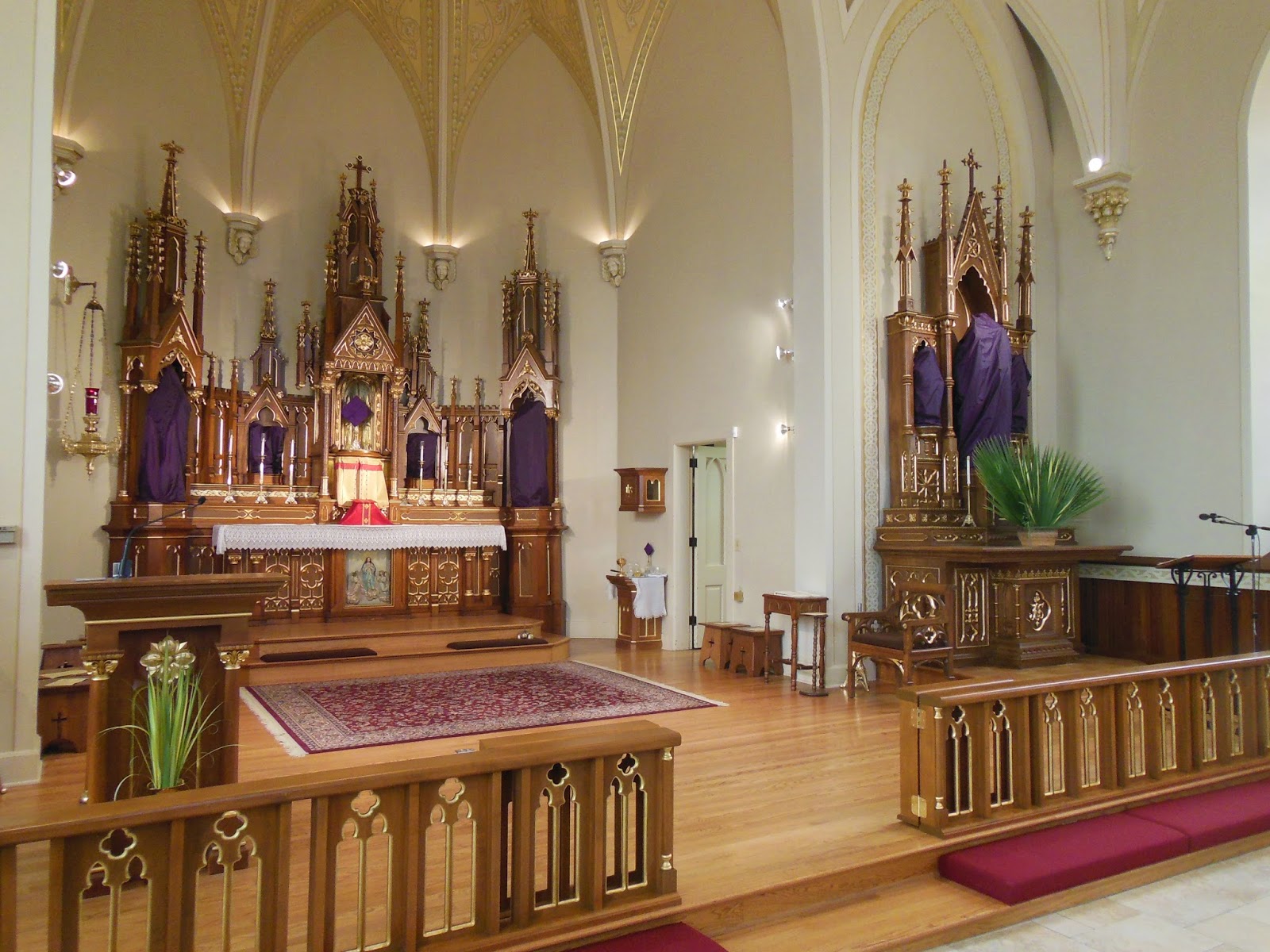
Veiled in Lent at St. Mary's, Pine Bluff


Veiled in Lent?  What does this mean?  One does not simply cloak themselves literally with a liturgical season.  Heck, how often does the average person hear the term "liturgical season?"  

Take a closer look at the altars folks.  Where are the statues?  Aha!  Cloaked in purple, the representative color for the Lenten season.  Not every church follows this tradition.  In fact, I have only heard of a few. However, just fifteen miles west of downtown Madison, St. Mary's in Pine Bluff puts their statuary under wraps for the last weeks of Lent.


I do not know the history of St. Mary's yet, but the set of vintage-looking Gothic Revival altars look like they could be quite new.  From a smattering of blog posts I've run into, this parish community seems very active in its religious life, including in their care of the sanctuary.


These impressive altars should be getting all the more attention from the parishioners as the commonplace "table altar" is absent.  At St. Mary's, Mass is offered ad orientum, with the priest facing "liturgical east" (towards the high altar).  This is definitely a step toward older traditions in the Catholic Church, mostly before the Vatican II council of the early 1960s.


Left: Side altar featuring St. Mary under the larger veil.
Right: Detail from the base of St. Mary's side altar.

The tradition of veiling statues and other artwork within churches late in Lent appears to have murky origins possibly tied to the Lenten veils[1] which have been used in some Old World churches as far back as the 7th Century[2].  The sources I have included at the end of the post offer more insight into the history behind the use of Lenten veils in St. Mary's and elsewhere.


St. Mary of Pine Bluff Catholic Parish
3673 County Highway P, Cross Plains, WI 53528

Thanks to the parish priest and a few of the parishioners who let me take these photos and provided some context about the parish during my short visit.  Hopefully I can make another photo visit soon!

Additional Sources