Wednesday, May 13, 2015

"Roots in Faith" Party and Final Mass at the circa 1902 St. Cecilia Catholic Church, Wisconsin Dells


St. Cecilia Catholic Church is on the verge of building a new church to host its parishioners and the droves of guests that frequent the Wisconsin Dells. A necessary part of this process involves taking down the current church building, built in the early 1900s. The last Mass at the old church will be celebrated at 5pm on Sunday, May 17th, with a "Roots in Faith" party afterward. At that gathering, historic photos will be on display, hogs will be roasted, and a celebration of the faith history in the Dells should ensue. If you are connected to St. Cecilia's in some way or are otherwise interested in the event, check out the parish's announcement here.

In anticipation of this project, I stopped at the church last weekend to take photos, a couple of which are included in this post. Fr. Eric Sternberg, who granted approval of my photo shoot, and the parish have made an effort to keep the glow of Easter season decor alive in the church up to the day that the last Mass is given. I hope to share highlights of my visit soon.


St. Cecilia Catholic Church

Thursday, May 7, 2015

St. Joseph Catholic Church, Waukesha, Part 1 - Exterior


St. Joseph's in Downtown Waukesha is one of the oldest churches in this historic, now largely suburban area, to the west of Milwaukee. A co-founder of Milwaukee, Solomon Juneau, donated land that this parish complex thrives on today back in 1843, five years before Wisconsin was admitted into statehood[1]. This Gothic Revival structure is the third church building for the parish.


According to Parish history text, this building was completed in 1890, with the cornerstone (above, left) noting construction of the parish moving ahead two years prior. At right is a marker denoting the church as an official city landmark, a designation the church earned in 1983 [2].


The prominent steeple draws the visitor's eye upward, its alternating bands of colored slate adding a nice touch. The Wisconsin Historical Society's record for St. Joseph's remarks that the church is specifically a fine example of High Victorian Gothic [3].


The arched windows continue to mark the Gothic style. The firm of Adolphus Druiding designed St. Joseph's. Just a few years later, the Druiding team designed another church visited by the blog, St. John Cantius in Chicago. The limestone chosen for the church and some of its partner buildings on the parish campus make for a pleasing exterior.


As a cartographer by passion, I was thrilled to see a map of the parish complex, although I found it slightly odd that the map is located squarely in the center of the campus (see the faint "you are here" label in the center of the map)! The church, chapel and parish activity center that I photographed are all in the upper left-hand (northeast) corner of this map.


The front doors to the old parish school, now parish activity center. Part of this building was actually built from the church that preceded the current St. Joseph's Church, built roughly in 1848. If I had realized this fact while taking photos, I would have examined this building in more detail.


Core to the vitality of this parish is its Hispanic community.

A quick note for context: These photos were shot awhile ago, in June 2014, with plans to make a more-intensive church architectural and historical review.  I chatted with the parish priest, Father Bill Key, who offered a wealth of parish history and gave me a tour of the church before leaving me to shoot photos.  Furthermore, a friend of mine put me in touch with the Wisconsin Historic Society who also has a treasure trove of information about Wisconsin's historic churches.  With other projects and the need to get other posts online, I finally started putting this post, the first of three, together this winter. This post and its forthcoming partner posts rely heavily on the histories shared with me by the parish and state historical society.


St. Joseph Parish


Additional Sources:

[1] History of St. Joseph's Parish. Written approximately 2006. Provided in photocopy by Fr. Bill Key.
[2] Waukesha Comparison National Register of Historic places (NHRP) Local Landmarks List. http://www.ci.waukesha.wi.us/c/document_library/get_file?uuid=7f6f145a-2e1e-4dbb-8b4c-9f73803c7a9c&groupId=10113
[3] 818 N East Ave, Wisconsin Architecture and History Inventory. http://www.wisconsinhistory.org/Content.aspx?dsNav=Ro:20,Nrc:id-4294961467-dynrank-disabled,N:4294963828-4294963814&dsNavOnly=N:1159&dsRecordDetails=R:HI16808

Monday, May 4, 2015

Roamin' Catholic Churches Talks That Milwaukee Talk


A quick post while I get ready to release another multi-part series of church photos: Last month I was asked to write about Doors Open Milwaukee (which I discuss on this blog here and here) for OnMilwaukee.com, an online newspaper that is all about those happening things in the Cream City. The article came out on April 30th.

Over roughly 1,800 words, I explain the importance of residential neighborhoods and the special places inside of them, including churches. Specifically I referenced St. Stanislaus Catholic Church on Milwaukee's south side and St. Casimir Catholic Church (pictured above) in the north side's Riverwest neighborhood. St. Casimir's along with being a wonderful Gothic Revival church building was also likely the parish of choice for my Polish great-grandparents who spent at least a little time living in the second house from the left in the photo above.

Many thanks to my dear friend and Doors Open Milwaukee Program Manager Amy Grau for giving me the opportunity to chime in with my thoughts of Doors Open and Bobby Tanzilo, editor at OnMilwaukee.com for his help in getting the article online!

Oh my goodness! Oh my goodness! While looking Bobby's bio at OnMilwaukee.com for this blog post, I came across an article that he released on April 28th on "Mad Man" Michaels, a Milwaukee disc jockey best known for his handful of Polish Christmas story records. I've known of these records since my mother introduced the stories to me in the late 90s. Bobby's article includes all of the recordings of the "Bard of Mitchell Street," who I think I have heard was actually Irish. Give them a listen (I have nothing to say about the copyright rules involved here)!


St. Casimir Catholic Church - Our Lady of Divine Providence Parish
http://ourladyofdivineprovidence.weconnect.com/


Sunday, March 8, 2015

Our Lady of the Lake Catholic Church, Ashland


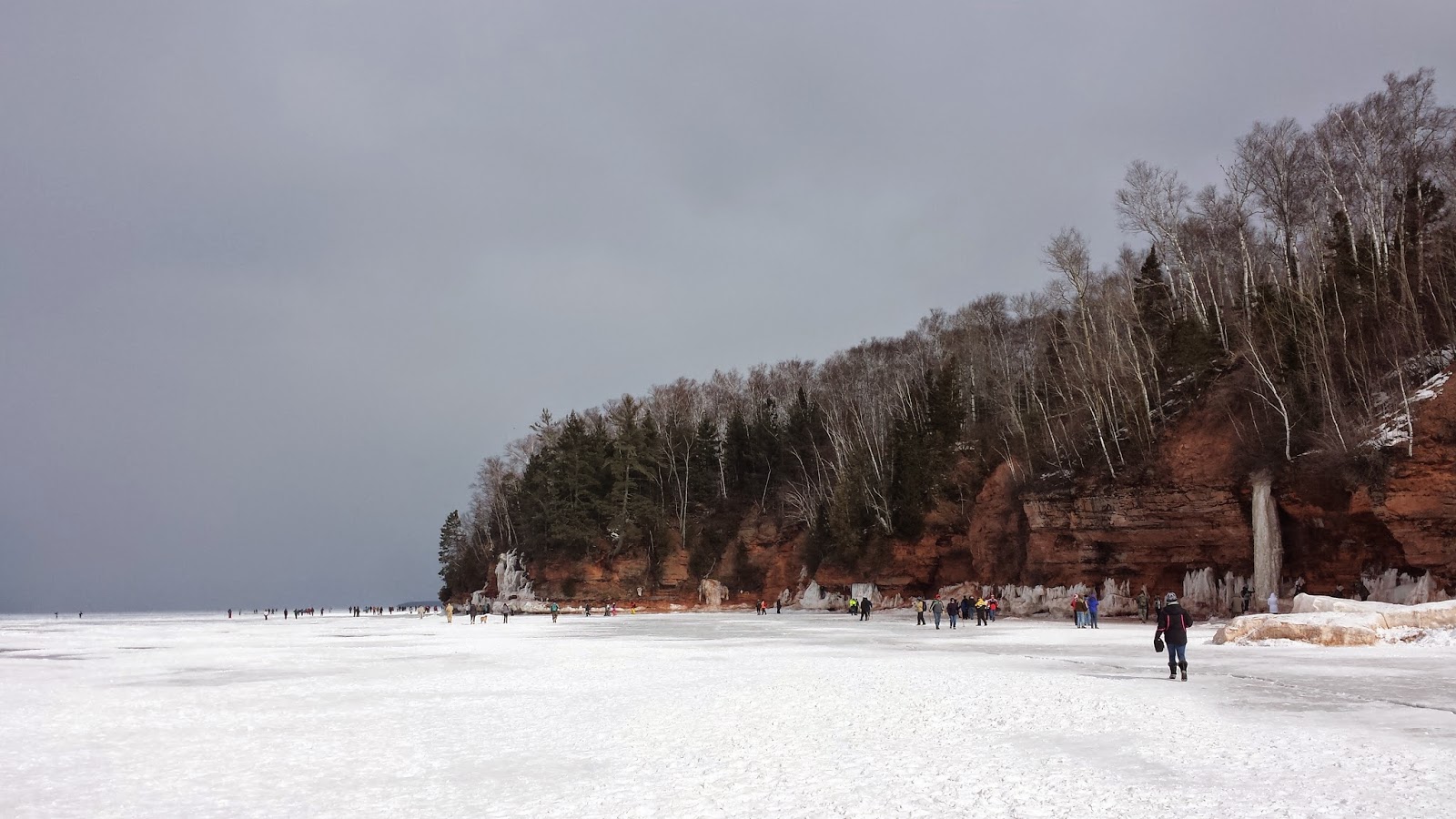
I was fortunate enough last weekend ago to go and visit the ice caves at the Apostle Islands National Lakeshore with some family members.  While waiting for a flat tire repair (not every trip goes without its quirks) I got to stroll around this wonderful old church building in downtown Ashland.


What is now the church of Our Lady of the Lake originated as St. Agnes Catholic Church in the 1870s.  The present structure is the second St. Agnes Church in Ashland, and took a decade to complete.  Furthermore, the St. Agnes name has largely been overtaken by Our Lady of the Lake with the merger of St. Agnes and the Polish Holy Family Catholic parish in the early 1990s [1].


The church building is a lovely and locally rare example of Gothic Revival architecture from what I read with the Wisconsin Historical Society and my limited visits up north [2].  However, it's the brownstone that is most striking as one strolls around the church.   


Brownstone is an important part of Ashland's building stock, as quarries on the nearby Apostle Islands were used to build up some of the region's early institutional buildings [3].  A stroll up Main Street in Ashland will offer a view at its historic City Hall building, among other impressive buildings from the city's heyday as an mining port city for the Apostle Islands and the nearby Gogebic iron range.


In case you can't tell from the differing shades of red and brown, shooting photos of this church in the very bright mid-afternoon sun presented a bit of a challenge during photo-editing.


To the right in this photo is the parish school building, while parish offices are in the building on the left.  Full disclosure: I hear there are fine Gothic altars inside, and I want to get back and see them one of these days!


Our Lady of the Lake Catholic Church
http://www.ourladycc.org/church/


Additional Sources
[1] http://www.ourladycc.org/church/about/history/
[2] http://www.wisconsinhistory.org/Content.aspx?dsNav=Nrc:id-4294961467-dynrank-disabled,N:4294963828-4294963814&dsNavOnly=N:1073-4294963829&dsRecordDetails=R:HI4349
[3] http://www.wisconsinhistory.org/Content.aspx?dsNav=Ny:True,Ro:0,Nrc:id-4294961467-dynrank-disabled%7cid-4-dynrank-disabled,N:4294963828-4294963814&dsNavOnly=N:1073-4294963829&dsRecordDetails=R:HI49


Postscript: Did I really just say that I went to the Apostle Islands ice caves and not offer a picture?


It doesn't take much to twist a trip to the ice caves into its own sort of semi-religious experience, however most of my photos from the day tremble at the though of expressing this.

Sunday, February 1, 2015

Septuagesima Sunday (A Housekeeping Post)


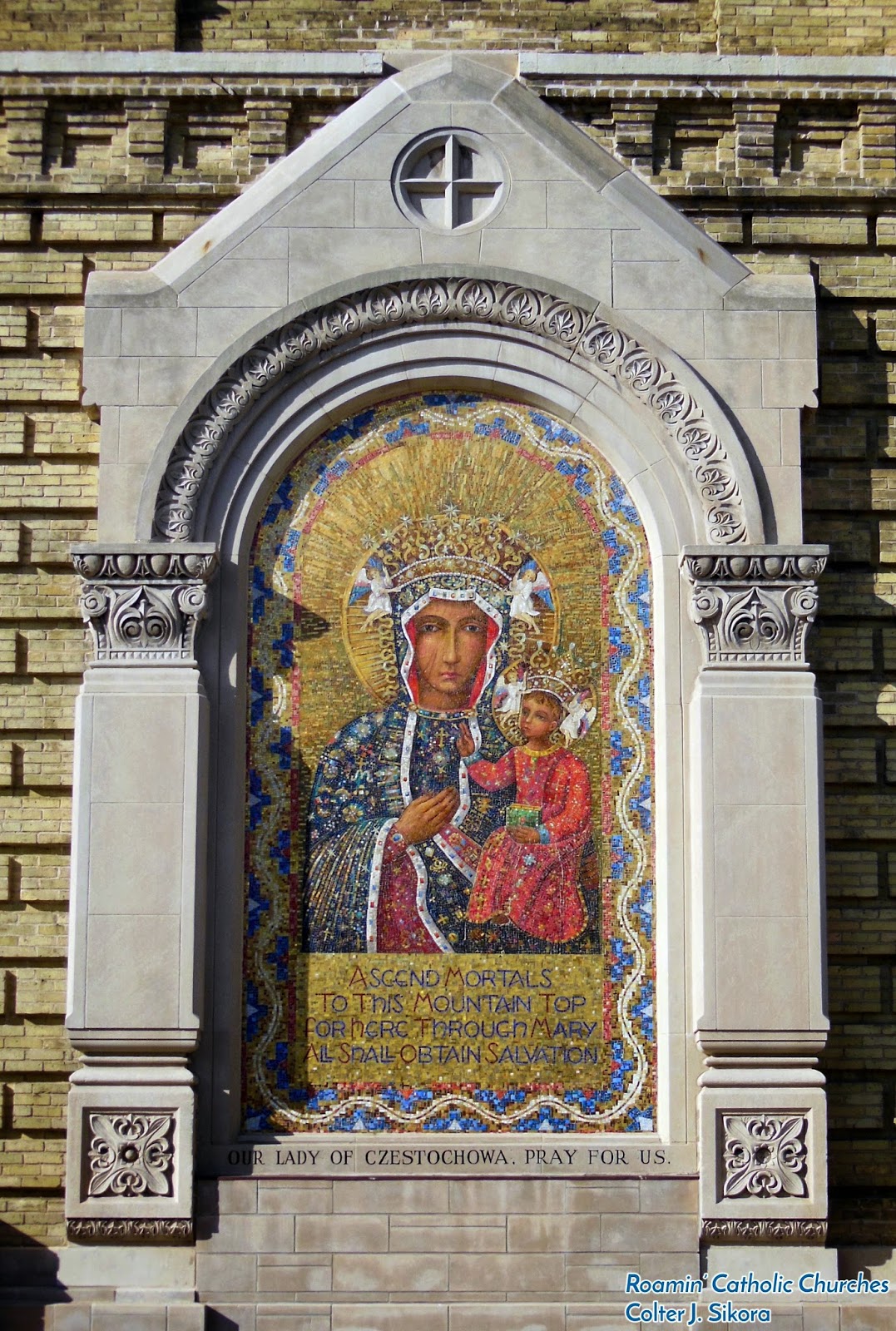
"Ascend Mortals To This Mountain Top For Here Through Mary All Shall Obtain Salvation.
Our Lady Of Czestochowa, Pray For Us."
From St. Stanislaus Catholic Church in Milwaukee.

Now that I have finally posted all of my "Advent" photos and caught up with the Doors Open Milwaukee posts, I now have a little bit of time to take stock in what is going on with Roamin' Catholic Churches.  First, websites like this don't matter much at all without interest from readers who take the time to read, share, and hopefully be entertained by these posts.  In the fast few weeks especially, a number of fine folks have taken a look at the site and shared some of the last few posts or a link to the blog homepage.  For these things, I thank you all!

To my understanding, the sites below have shared a link, photo, or article snippet.  They each post a lot of interesting content in their own right, depending on where your interests lie, and they are all worth least a look.  

The Badger Catholic - (Mostly) Wisconsin Catholicism, also has church photos.: http://badgercatholic.blogspot.com/

Imprisoned In My Bones - Various Catholic topics, focus on the Archdiocese of Milwaukee.: http://annebender.blogspot.com/

Catholic Architecture and History of Toledo, Ohio - Church architecture and artwork blog focused on the Diocese of Toledo.: http://catholictoledo.blogspot.com/

Dumb Ox Writings - "Commentary and so forth from a Catholic in Milwaukee.": http://latinandabeer.blogspot.com/

St. Stanislaus Oratory's Facebook Page: https://www.facebook.com/ststanislausmilwaukee

I have to make some updates to the blog itself (not the content) soon, and I hope that I get the manuscript and photos ready for the next bigger blog post going soon.  Stay tuned!

Also, from the encouragement of a friend and blog reader, I am adding basic credits to the photos for now.  Then again, I still am not that thrilled with my own photography.  In the event that you do want to use any of these photos beyond blog posts, please email me at roamincatholicchurches@gmail.com and we will work something out.


Sunday, January 25, 2015

Event Report: Doors Open Milwaukee 2014, Part 2


Picking up from the first part of this series (which I posted about two months ago), here we have Milwaukee's answer to the uptake in Latin Mass communities.  St. Stanislaus Oratory is currently southeastern Wisconsin's sole home for the Institute of Christ the King Sovereign Priest.  The Institute, based in Chicago, is probably best known for bringing the old Latin Mass back to a number of cities across the country.  


In light of the Latin Mass being celebrated here, you see everything on the high altar oriented to where the Eucharist should be.  "Should be" because during the tours for Doors Open Milwaukee, the priests moved the Eucharist out of the tabernacle (top of this photo) to help avoid irreverent movement around the Host. 


Left: Reliquary containing a relic of St. Thomas, Apostle and Martyr.
Right: One of two angels flanking the high altar. 


An important trait about the Institute: They seem quite intent on restoring the oftentimes historic church structures that they occupy.  The major theme for the discussion about the church at Doors Open was the planned restoration project aimed at bringing the church near it's original look from the late 1800s.  I say this here as one of the priest's particular speaking notes was directed to the Polish White Eagle at the top of this photo.  The White Eagle has been a significant Polish icon for generations and the crest shown here is original to the church (Milwaukee's Polish "mother" church).  Just out of view of the picture is a big speaker that keeps the White Eagle practically hidden from most of the church.  Among many other changes, the speaker system is supposed to be altered to reveal this Polish iconography once again.


St. Mary, beneath the Cross.  


A beautiful dome mosaic above the Sanctuary.  


"...and that Musky was this big coming out of the water!"  Just kidding, but this is what comes to mind every time I see this picture.  The summary of the planned church restoration was well delivered, even without fish tales.


Doors Open Milwaukee attendees mill around in the Sanctuary asking questions after the presentation.


St. Stanislaus is another of the more fortunate churches in the inner-city Midwest.  Like many of the Chicago churches that I reviewed around the holidays, it came to life by way of a strong group of immigrants.  As the neighborhood changed and daughter parishes sprung from the original St. Stanislaus parish boundaries, attendance decreased drastically.  Similar to St. John Cantius in Chicago, St. Michael in Wausau, and St. Francis de Sales in St. Louis (the latter two I need to write articles for someday) an enthusiastic community giving the Latin Mass arrived and gave St. Stanislaus new life.  The restoration plans should only help bolster the local church community and the surrounding neighborhood.


St. Stanislaus stands next to its former school building, just off of Historic Mitchell Street, the "Polish Grand Avenue" of years past.  The street is now thriving as a center of commerce for Milwaukee's Hispanic community.


With over 150 different sites to visit, Doors Open Milwaukee has been an increasing success in each of its four years.  Catholic sites have been a mainstay in the event since its beginning, and I can only anticipate that this will continue.  It certainly is a great way to break out of one's shell for a weekend and see how other churches, businesses, landmarks, and the people that run them in Milwaukee go about their existence.

Also, a great article describing the upcoming restoration at St. Stanislaus can be see here from Bobby Tanzilo at OnMilwaukee.com: http://onmilwaukee.com/buzz/articles/ststans.html?viewall=1


Additional Sources and a Disclaimer
I have been volunteering and been enthusiastic about the effort that Doors Open Milwaukee and its mother organization, Historic Milwaukee, Inc. have made for over two years now.  Certainly I believe their annual event is worth attending, along with the numerous other programs that Historic Milwaukee, Inc. puts on.