Monday, April 28, 2014

Roadside Stop at St. Mary's of Częstochowa, Junction


An interesting stopover on the way to somewhere else...here is another closed church, St. Mary of Częstochowa in northwestern Clark County.  Opened effectively, if not officially, as a Polish ethnic parish, it stands at the crossing of two nondescript gravel roads that earned the glamorous place name of Junction (you can see it in DeLorme's atlas of Wisconsin).  The area around the church is not heavily populated, which probably led to the parish's closing in 1996.  However, on the last Saturday of the month, I am told the parish priests from nearby All Saints (Boyd/Cadott/Stanley) and St. Bernard/St. Hedwig's (Thorp) do Mass at this church.

I am not sure what the building's condition is, but I think the main altar is centered on a rendition of the Black Madonna of Częstochowa painting for which the parish is named.  


St. Mary of Częstochowa Catholic Church


Wednesday, April 16, 2014

Veiled in Lent at St. Mary's, Pine Bluff


Veiled in Lent?  What does this mean?  One does not simply cloak themselves literally with a liturgical season.  Heck, how often does the average person hear the term "liturgical season?"  

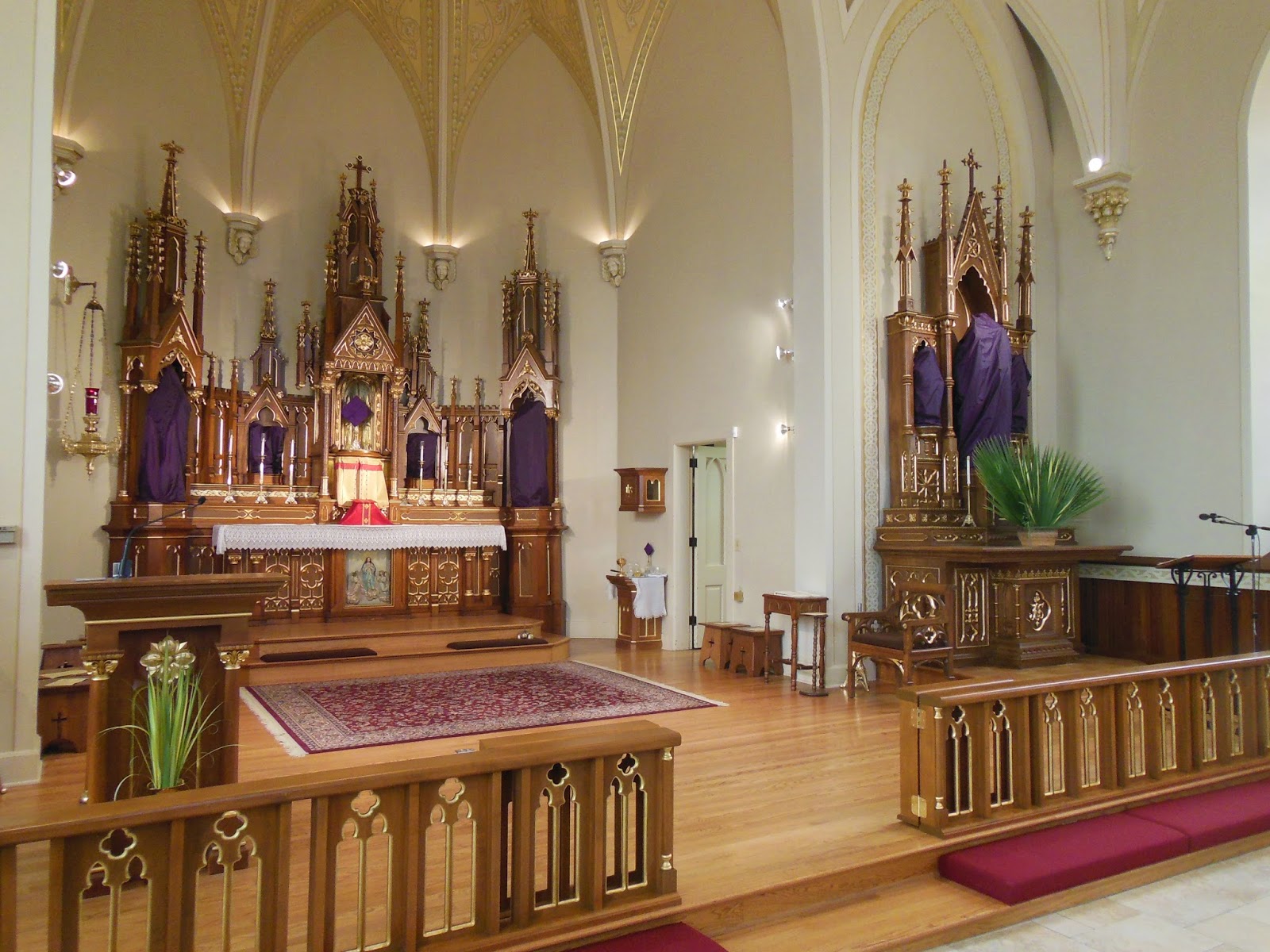
Take a closer look at the altars folks.  Where are the statues?  Aha!  Cloaked in purple, the representative color for the Lenten season.  Not every church follows this tradition.  In fact, I have only heard of a few. However, just fifteen miles west of downtown Madison, St. Mary's in Pine Bluff puts their statuary under wraps for the last weeks of Lent.


I do not know the history of St. Mary's yet, but the set of vintage-looking Gothic Revival altars look like they could be quite new.  From a smattering of blog posts I've run into, this parish community seems very active in its religious life, including in their care of the sanctuary.


These impressive altars should be getting all the more attention from the parishioners as the commonplace "table altar" is absent.  At St. Mary's, Mass is offered ad orientum, with the priest facing "liturgical east" (towards the high altar).  This is definitely a step toward older traditions in the Catholic Church, mostly before the Vatican II council of the early 1960s.


Left: Side altar featuring St. Mary under the larger veil.
Right: Detail from the base of St. Mary's side altar.

The tradition of veiling statues and other artwork within churches late in Lent appears to have murky origins possibly tied to the Lenten veils[1] which have been used in some Old World churches as far back as the 7th Century[2].  The sources I have included at the end of the post offer more insight into the history behind the use of Lenten veils in St. Mary's and elsewhere.


St. Mary of Pine Bluff Catholic Parish
3673 County Highway P, Cross Plains, WI 53528

Thanks to the parish priest and a few of the parishioners who let me take these photos and provided some context about the parish during my short visit.  Hopefully I can make another photo visit soon!

Additional Sources

Thursday, April 3, 2014

Old St Bruno's, Dousman

Breaking new ground with this post...for the first time on this blog, we are exploring a closed church.  Even when a parish has vacated a church building, the story of the structure and the parish itself is still unfolding in an empty or maybe forgotten edifice.  Old St Bruno's on the western edge of Waukesha County validates this point.


This Old St.Bruno's Catholic Church (there was one more church built before and after this one) was built in 1887 for a largely rural congregation.  As the original settlement near the church shifted a couple miles east to present-day Dousman, this church was closed in the mid-1950s.  For being closed for nearly sixty years though, the church appears to have aged relatively well.  My tour guide, St. Bruno's parish priest, gave me a good summary of why we see Old St Bruno's in the shape we do today.


In the early 1990s, several parishioners worked on their own initiative to bring life back to Old St. Bruno's.  I do not have any record of what the church looked like before their restoration project, but among other things, pews were acquired from another church and new artwork was picked for the Stations of the Cross.  It also looks like the items on the high altar were re-assembled for the old Latin Mass, as the sheets on the altar appeared to be written out for that purpose.


The paint on the high altar and its statues looked like it was in good shape.  The detail on this Gothic high altar is striking, especially in the context of a simple rural church.


The Lamb of God, called up in Mass, but not easily noticed in ecclesiastical art.  Here the Lamb of God is sitting on a book depicting the seven seals of the Apocalypse, from the Book of Revelation.[1]


The statuary too may have come from a hodge-podge of places according to Father.  This holy water font-bearing angel is in the sacristy not far from the high altar.


The side altars too are intricately designed and look well cared for, despite the fact that regular maintenance apparently hasn't continued since the restoration efforts twenty years ago.  Mostly lit by the afternoon sun, this statue of Mary looks particularly nice.


Left: St. Joseph
Right: St. Therese de Liseux


A look at the pews.  I'm not sure how often the Building Fund box is checked for contributions.  Behind locked doors, it's painfully hard to contribute!


St. Bruno's has had four different church buildings in its history.  Its current church does have a few pieces that originally were at Old St. Bruno's.  Above is a statue of St. Bruno himself.  Although Father told me a lot about the long and hermetic life of the German saint, the fact that I remember best is that the religious order he founded, the Carthusians, are makers of Charteuse liqueur.  After dinner drinks anyone?


IX  Jesus falls for the third time.

The Stations of the Cross came from Old St Bruno's and were "antiquated" by an artist in Door  County for the present church building.  I found these statues quite tasteful for the current church interior.  Placing them lower on the walls and having lights directly above the Stations allows many visitors to give the Stations a closer look and more seriously consider the Stations and the artwork itself.


II  Jesus carries his Cross.  Detail.


Back at Old St.Bruno's a neighbor keeps a birdhouse, or possibly a Little Old St. Bruno's, complete with a cornerstone (not shown).


Old St. Bruno's Catholic Church, St. Bruno Parish

St. Bruno's Catholic Church, St. Bruno Parish

Additional Sources
[1]http://www.romeofthewest.com/2008/02/photos-of-saint-peter-church-in-saint.html

Monday, March 17, 2014

Happy St. Patrick's Day!


St. Patrick's Day celebrations are seemingly everywhere today.  Milwaukee hosted its downtown St. Patrick's Day Parade this past Saturday.  Prior to that, the Wisconsin Shamrock Club partnered with Our Lady of Guadalupe/St. Patrick Parish to have a special St. Patrick's Mass at the namesake church.

This church dates back to 1893, although I believe it is not the first church of the St. Patrick congregation in Milwaukee. The old school building, to the left, dates from 1876.  Originally built for the Walker's Point and south side neighborhood Irish Catholics, St. Patrick's has merged with Our Lady of Guadalupe (formerly Holy Trinity) and serves part of Milwaukee's Mexican-American community.


With help from the Shamrock Club, the church has been well-restored in recent years.  Notable is the Celtic/Irish influence on many features. 


Displayed on a side altar, this statue of Mary was recovered from a fire which severely damaged St. Patrick's in the past as I was told.  I am not sure if this fire was to the current St. Patrick's building, or perhaps an earlier blaze, as the neighborhood around the church saw at least a couple devastating fires around the turn of the 20th Century.

 St. Patrick


Likely with help from the restoration effort, the windows looked pristine.  I didn't have enough time to take full stock in all of the windows, but they highlighted a number of saints and religious figures that I don't see in most churches.  Click on any of these photos to see them in greater detail.


I was fascinated by these dormer-like windows on the church roof.  These windows provide light into the higher row of stained glass windows that you see at the top of the second photo in this post.


How do three-foot Celtic door hinges not catch your eye?


The school building, now home for Notre Dame Primary School, has a richly detailed face.  Note especially the detail near the top of the portico.


St. Patrick Catholic Church, Our Lady of Guadalupe/St. Patrick Parish

Additional Sources

Monday, March 10, 2014

Ash Wednesday


A few days late for Ash Wednesday, but it is certainly Lent now, as the purple cloth on this communion rail implies.  From Holy Redeemer Catholic Church in Madison.


Holy Redeemer Catholic Church, Cathedral Parish


Saturday, February 22, 2014

St. Joseph Catholic Church, Boyd

Here are pictures of St. Joseph Church, in Boyd, Wisconsin.  This church is part of the All Saints Catholic Community of Boyd, Cadott, and Stanley.  St. Joseph’s is 189 road miles northwest of Madison's Cathedral Parish and the State Capitol.


For a small-town church, St. Joseph's has an impressive group of statues.  Most visible among these are on the high altar on either side of the Crucifix.  Click on any of these photos to view a larger version.


Left: St. Patrick, Bishop and Patron of Ireland  
Right: St. Boniface, Bishop, Martyr, and Patron of Germany


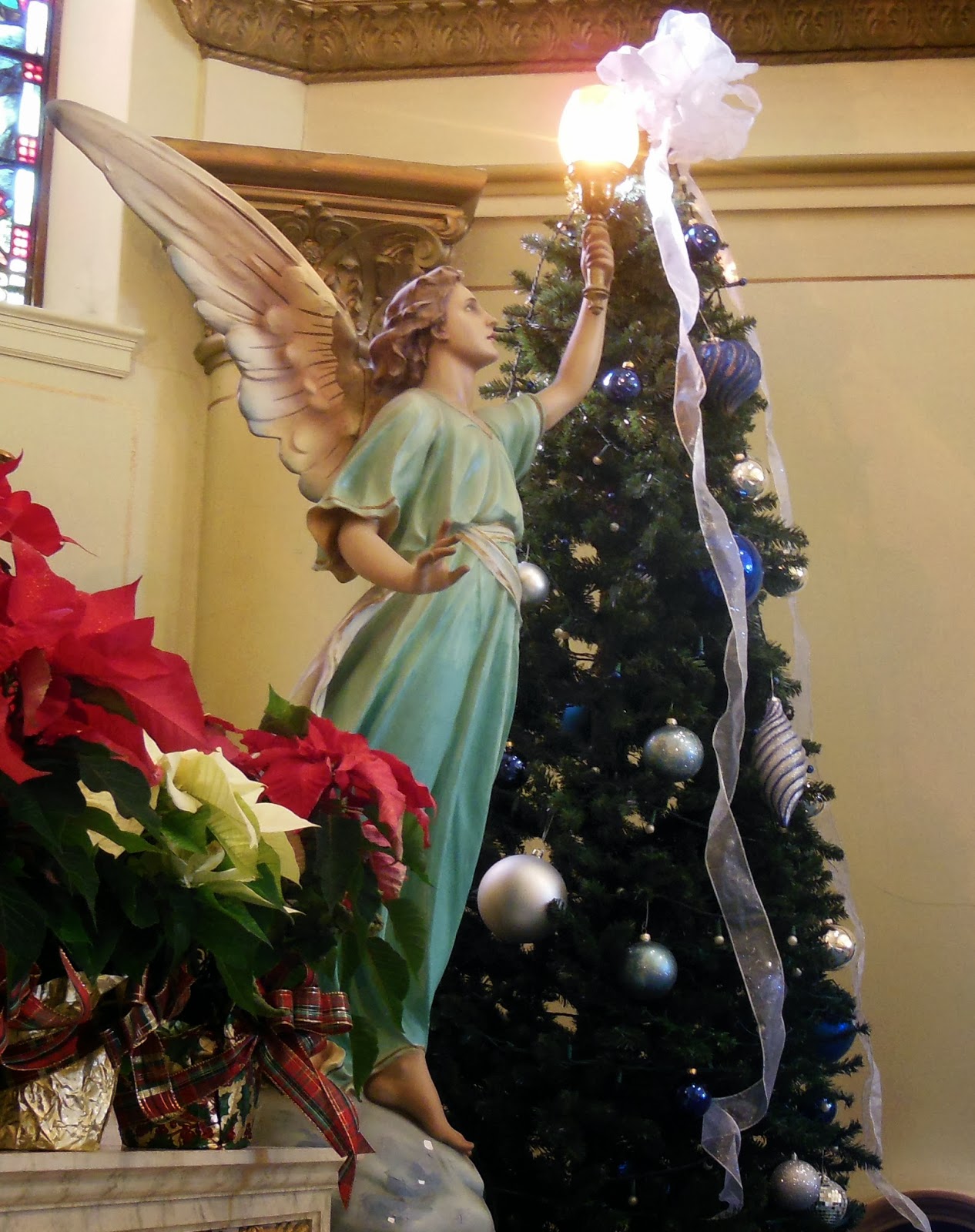
It is common practice in Catholic churches to have a pair of angels positioned on opposite sides of the tabernacle.  Equipped with modern day torches, they make a striking presence with the Christmas trees. These photos were taken on the third day of Christmas.


From the front altar.


A great effort to revive the beauty in these statues is taking place.  A parishoner has taken several of the fading statues and repainted them back to life.  Above are pictures of St. Elizabeth of Hungary, found in the church basement, from March 2012 (left) and December 2013 (right).  One can only hope this effort continues for all the statues in this church.  A look at the statue's base indicates that it was made by Daprato Statuary Company based in Chicago, which is still in business as Daprato Rigali Studios.

From what I have found, St. Joseph's is not known for having a dominant single ethnicity among its churchgoers.  Perhaps as a result, we see statues of French, German, Hungarian, Irish, and other saints spread throughout the church.


Though it is hard to tell, I believe this is St. Aloysius Gonzaga, an Italian who aspired to the priesthood though he died before ordination.  Poland's St. Stanislaus Kostka has a similar history, but most artwork of St. Aloysius displays him carrying the Cross in addition to lilies, alluding to his practiced chastity.[1]  I chose to display this photo in grey scale as the sacristy window made conditions too bright to photograph in full color.


Infant of Prague


Easily the most curious statue display in the church.  In one of the steeples, a room stores the hidden statues of Saints Michael the Archangel, Vincent de Paul, Mary with her Immaculate Heart, and Catherine of Alexandria.  All of these statues are in various states of disrepair, but even with chipped paint and parts broken off, fine artistry is still evident.


Detail of St. Catherine of Alexandria, Queen of Egypt and Martyr.


St. Joseph and Child.


XII  Jesus dies on the cross 


Also impressive at St. Joseph's are the stained glass windows.  Again, the parish community picked an out-of-state company to bring these to life, now Emil Frei & Associates of St. Louis.  


Donated by Catholic Order of Foresters Sisters Court No. 1433


An unusual window in Midwestern churches perhaps; St. Margaret Mary Alacoque with Jesus, revealing His Sacred Heart.  This and other visions came to St. Margaret Mary in the 1670s, helping set the foundation for Catholic devotion to the Sacred Heart to this day.[2]


View from the choir loft.


St. Joseph is also the home base for the All Saints parish school, seen to the left of the church.  After having schools open in Boyd, Cadott, and Stanley at various points, the Boyd school location (also named for St. Joseph) was selected to reopen to students at the beginning of the 2013-2014 school year.  In the church basement, which also doubles as the school cafeteria, old St. Joseph's School memorabilia make a colorful appearance.


St. Joseph Church, All Saints Catholic Parish

Many thanks to the parish Priest and Head of Maintenance who guided my visit and allowed me to photograph St. Joseph's.

Additional Sources